
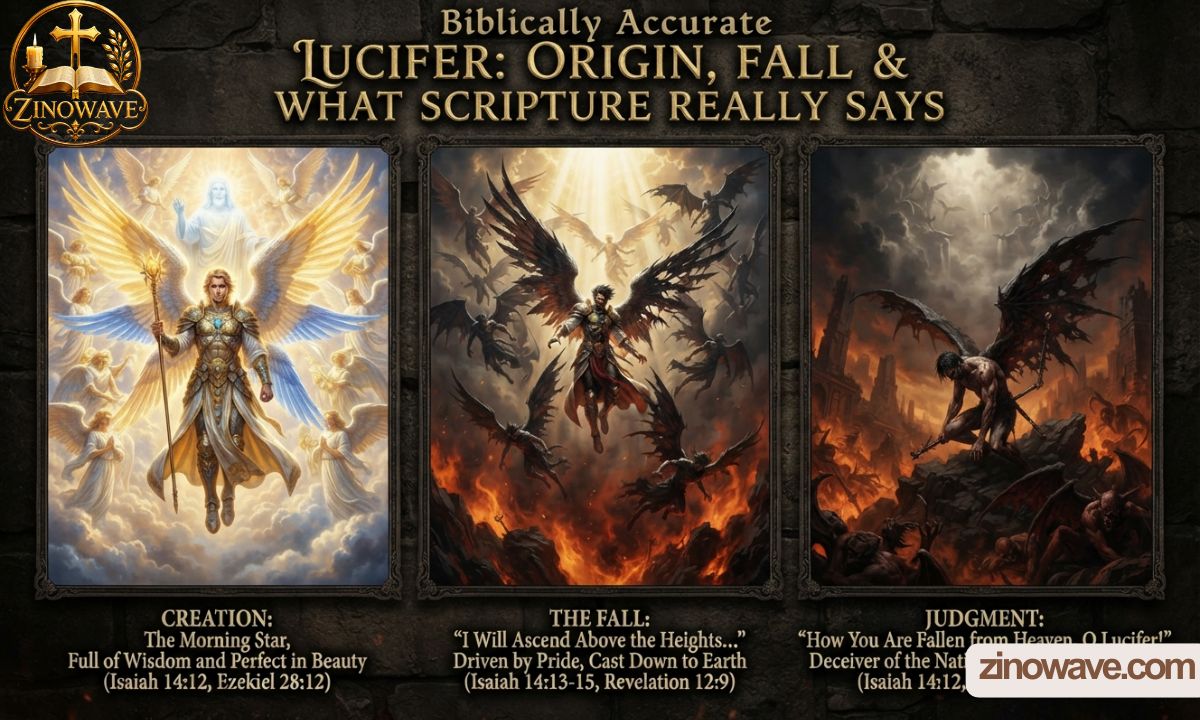
When most people hear the name Lucifer, they picture a red-skinned devil with horns, a tail, and a pitchfork. Surprisingly, the Bible never describes Lucifer this way. Much of the popular image comes from medieval art, literature, and later Christian tradition rather than the biblical text itself. Scripture presents a far more complex and debated figure one associated with beauty, wisdom, pride, and a dramatic fall from a position of honor.
This guide explores the biblically accurate understanding of Lucifer, examining what passages like Isaiah 14 and Ezekiel 28 actually say, the origin of the name “Lucifer,” and how centuries of interpretation shaped modern beliefs. By separating biblical evidence from cultural tradition, you’ll gain a clearer understanding of one of the Bible’s most discussed and misunderstood figures.
Biblically Accurate Understanding of Lucifer’s Identity
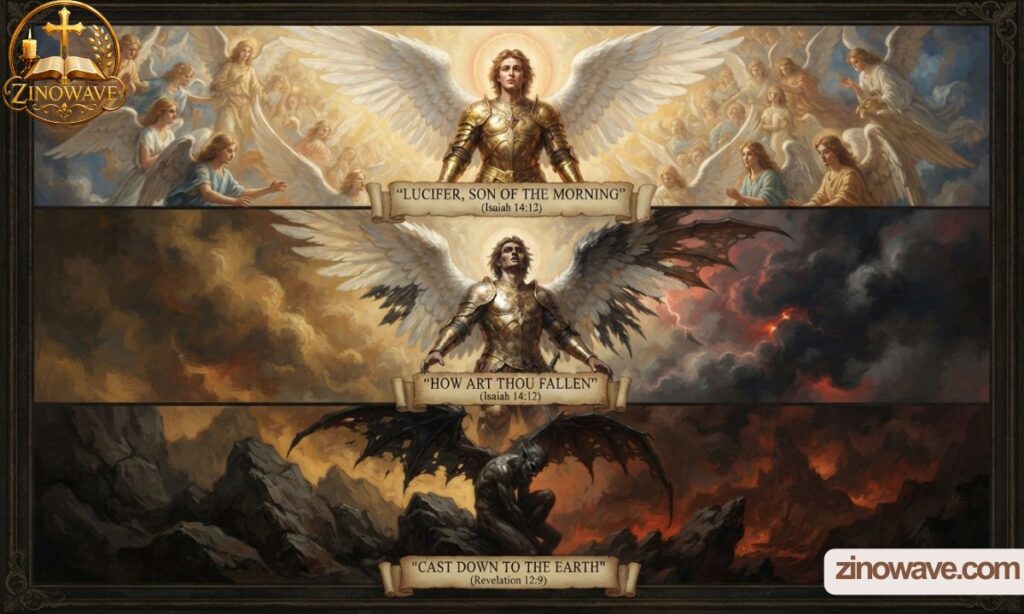
The name “Lucifer” appears only once in most English Bibles, in Isaiah 14:12 (KJV). It isn’t a title used elsewhere in Scripture, and it was never meant as a personal name in the original Hebrew text.
Understanding who Lucifer really is requires going back to the original language, the translation history that shaped English Bibles, and the handful of passages scholars connect to this figure primarily Isaiah 14 and Ezekiel 28.
Common Misconceptions About Lucifer in Modern Culture
Popular culture has layered centuries of imagery onto Lucifer that has no biblical basis. Common misconceptions include:
- That Lucifer is explicitly named as Satan throughout the Bible
- That he is described with red skin, horns, and a pitchfork
- That Isaiah 14 provides a complete, literal narrative of a heavenly rebellion
- That “Lucifer” was his given name before the fall, rather than a Latin translation choice
Most of these ideas come from medieval art, Dante’s Inferno, and Milton’s Paradise Lost — not from Scripture itself.
What Scripture Actually Reveals About Lucifer
The biblical text is far more limited and metaphorical than popular tradition suggests. Isaiah 14:12-15 describes a “shining one” falling from heaven after declaring intent to exalt himself above God.
Ezekiel 28:12-17 describes a cherub of remarkable beauty and wisdom who walked in Eden before corruption entered through pride. Whether these two passages describe the same being, a human king, or both through cosmic metaphor remains genuinely debated among scholars and denominations.
The Hebrew Original: Helel and Its True Meaning
The Hebrew word behind “Lucifer” is הֵילֵל (Helel), appearing only once in the entire Hebrew Bible, in Isaiah 14:12. It comes from the root halal, which can mean “to shine” or, in its negative sense, “to boast” or “to act arrogantly.
” The full phrase “Helel ben Shachar” translates to “shining one, son of the dawn,” commonly understood as a poetic reference to the planet Venus as the morning star. Because halal carries this double meaning, some scholars argue the name itself embeds a hidden irony describing radiant brilliance twisted into arrogant boasting.
Jerome’s Latin Vulgate and the Birth of ‘Lucifer’
Around 383 AD, the scholar Jerome translated the Hebrew Bible into Latin for what became the Vulgate. When he reached Isaiah 14:12, he rendered “Helel” as Lucifer, a Latin word combining lux (light) and ferre (to bear), meaning “light-bearer.” In Roman culture, this word already referred to the planet Venus as the morning star.
Jerome’s translation choice was linguistically accurate, but treating it as a proper name rather than a descriptive title set the stage for centuries of theological confusion. Notably, Jerome used the same Latin word “Lucifer” in 2 Peter 1:19, where it refers to Christ as the morning star.
King James Translation and English Christian Tradition
When the King James translators worked on Isaiah 14:12 in 1611, they retained Jerome’s Latin word “Lucifer” directly rather than translating it into English as “morning star” or “shining one.
” This decision cemented “Lucifer” as a proper name within English-speaking Christianity. Most modern English translations, including the NIV and ESV, instead render the Hebrew as “morning star” or “day star,” avoiding the personal-name implication the KJV created.
Biblically Accurate Description of Lucifer’s Appearance
Scripture never describes Lucifer with horns, a tail, or red skin. The only physical descriptions come from Ezekiel 28:13, which describes a being adorned with precious stones sardius, topaz, diamond, beryl, onyx, jasper, sapphire, emerald, and carbuncle and Isaiah’s poetic reference to him as a radiant “morning star.
” These are descriptions of glory and brilliance, not menace.
Lucifer’s Pre-Fall Glory According to Ezekiel
Ezekiel 28:12-15 offers the most detailed pre-fall description available in Scripture, describing this figure as:
- “The seal of perfection, full of wisdom, and perfect in beauty”
- Adorned with precious stones “in the day that thou wast created”
- An “anointed cherub that covereth,” positioned on God’s holy mountain
- “Perfect in thy ways from the day that thou wast created, till iniquity was found in thee”
This passage is directed at the King of Tyre, which is why scholars debate whether it describes a literal angelic being, a human ruler described in exaggerated cosmic terms, or both simultaneously.
The Morning Star Imagery in Isaiah’s Prophecy
Isaiah 14:12 uses the image of the morning star, one of the brightest objects in the night sky, to represent extraordinary former glory. In the ancient world, the morning star rises brilliantly before dawn, only to fade as the sun rises, a natural metaphor for a being who shines brightly before being outshone and cast down.
Isaiah applies this imagery directly to the King of Babylon in the surrounding verses, using cosmic language to describe a very real, historical fall from earthly power.
Does Lucifer Possess Physical Form After His Fall
Scripture doesn’t describe a physical body for Lucifer after the fall. As a spiritual being, later New Testament references to Satan describe deception and spiritual influence rather than physical description.
2 Corinthians 11:14 even warns that Satan can disguise himself as “an angel of light,” suggesting continued capacity for appearing radiant rather than monstrous, the opposite of medieval and modern depictions.
What Biblical Silence Tells Us Lucifer Is Not
Scripture’s silence on many details is just as informative as what it does say. The Bible never describes:
- A literal red or fiery-skinned appearance
- Horns, hooves, or a pitchfork
- A throne or kingdom in hell that he actively rules from
- A direct narrative connecting Isaiah 14 explicitly to a pre-human angelic rebellion
These absences highlight how much of the popular image comes from centuries of art and literature rather than the biblical text itself.
Symbolism and Meaning Behind Lucifer’s Role in Biblical Texts
Beyond any literal identity, the Lucifer passages function as powerful symbols within Scripture. They represent the danger of pride corrupting even the most gifted and beautiful of beings, the theme of a “great reversal” where the highest is brought low, and a warning against self-exaltation that appears throughout wisdom literature.
Whether read as history, metaphor, or both, the symbolic weight of the passage has shaped Christian theology for centuries.
Common Misinterpretations About Lucifer in Modern Culture
Beyond visual misconceptions, several theological misreadings persist:
- Treating Isaiah 14 as a complete biography of Satan rather than primarily a taunt against a human king
- Assuming “Lucifer” and “Satan” are used interchangeably throughout the Bible, when in fact “Lucifer” appears only once
- Reading later literary works like Paradise Lost as if they were scriptural rather than creative interpretation
- Overlooking that respected reformers like Calvin and Luther rejected the traditional Lucifer-Satan equation entirely
Critical Distinction Between Lucifer and Satan in Scripture
While Christian tradition often treats Lucifer and Satan as identical, the Bible itself never explicitly makes this connection. “Lucifer” appears once, in Isaiah 14:12, addressing the King of Babylon.
“Satan,” meaning adversary, appears dozens of times throughout Scripture in a very different context. The merging of these two figures into a single identity happened gradually through Christian tradition, not through a direct biblical statement.
Biblical Evidence Supporting Their Distinction
A few textual details support treating these as separate discussions:
- Isaiah 14:4 explicitly introduces the passage as a taunt against “the king of Babylon”
- The Hebrew word “Satan” does not appear anywhere in Isaiah 14
- The individual in Isaiah 14:15 is brought down to Sheol, a term associated with death and the grave, not a symbolic description of Satan’s ongoing activity
- Ezekiel 28’s parallel passage is directed at “the prince of Tyrus,” a human ruler, in its immediate context
How Christian Tradition Merged These Figures
Early Church Fathers, including Origen, Tertullian, and Augustine, began connecting Isaiah 14 and Ezekiel 28 with New Testament passages like Luke 10:18 (“I beheld Satan as lightning fall from heaven”) and Revelation 12:7-9.
Over centuries, these connections solidified into a composite narrative: a beautiful angel named Lucifer who rebelled, fell, and became Satan. This tradition became deeply embedded in Christian teaching, art, and literature well before it was ever seriously challenged.
Protestant Reformers’ Rejection of the Equation
During the Reformation, both John Calvin and Martin Luther explicitly pushed back against the Lucifer-Satan equation. Calvin argued that interpreting Isaiah 14 as referring to Satan arose “from ignorance,” insisting the context plainly pointed to the King of Babylon.
Luther similarly considered it a serious error to apply the verse directly to the devil, viewing the passage primarily as a political taunt rather than a cosmic biography.
Why This Theological Distinction Matters Today
This distinction isn’t just academic. How a passage is interpreted shapes how believers understand the nature and origin of evil, the reliability of extra-biblical tradition versus Scripture alone, and how confidently one can speak about details the Bible itself leaves ambiguous.
Recognizing the difference between what Scripture states directly and what tradition has added encourages more careful, humble biblical interpretation.
Biblically Accurate Account of Lucifer’s Fall and Significance
Regardless of how the Lucifer-Satan question is resolved, the fall narrative itself carries clear theological weight: a being of great glory chose self-exaltation over submission to God,
and the consequence was total, catastrophic removal from his former position. This pattern echoes throughout Scripture as a warning against pride in any form.
The Narrative of the Fallen Angel in Scripture
The traditional narrative, pieced together from Isaiah 14, Ezekiel 28, and Revelation 12, describes a being created in perfect beauty and wisdom who grew proud because of that very perfection, declared intent to exalt himself above God, was cast down as a consequence, and now opposes God’s purposes as an adversary.
It’s important to note this composite story isn’t laid out in a single passage; it’s assembled from multiple texts across centuries of interpretation.
Lucifer’s Five ‘I Will’ Declarations of Pride
Isaiah 14:13-14 records five statements attributed to this figure, each expressing self-exalting ambition:
- “I will ascend into heaven”
- “I will exalt my throne above the stars of God”
- “I will sit also upon the mount of the congregation”
- “I will ascend above the heights of the clouds”
- “I will be like the most High”
These five declarations form the theological centerpiece of the passage, illustrating escalating pride culminating in the desire to replace God entirely.
The Nature of Sin: Pride in God-Given Perfection
What makes this fall theologically significant is its source: not external temptation, but internal pride over gifts that were given, not earned. Ezekiel 28:17 states directly, “Thine heart was lifted up because of thy beauty, thou hast corrupted thy wisdom by reason of thy brightness.
” The very perfection and beauty this being was created with became the root of its downfall, a warning that even good gifts can become dangerous when they turn into self-worship.
Catastrophic Consequences of Angelic Rebellion
The consequences described in these passages are severe and complete. Isaiah 14:15 describes being “brought down to hell, to the sides of the pit.
” Ezekiel 28:16-17 describes being cast “as profane out of the mountain of God” and destroyed “from the midst of the stones of fire.” Whatever position and glory this being once held was entirely and permanently forfeited.
The Scope of Rebellion: One-Third of Angels
Revelation 12:4 describes a dragon whose tail “drew the third part of the stars of heaven, and did cast them to the earth,” a passage widely interpreted as symbolic language for a third of the angels joining in rebellion.
While this passage doesn’t explicitly name Lucifer, Christian tradition has long connected it to the same fall narrative, suggesting the rebellion was not a solitary act but one that drew significant numbers of other beings into the same fate.
Artistic Evolution of Lucifer’s Image Throughout History
The image most people associate with Lucifer today developed gradually over more than a thousand years of art and literature, moving further from Scripture with each era rather than closer to it.
Early Medieval Period: The Ethereal Blue Angel
In early medieval Christian art, fallen angels were often depicted as beautiful, ethereal beings, sometimes shown in blue or pale tones, distinguished from other angels mainly by posture or placement rather than monstrous features.
This period still reflected some connection to the “shining one” imagery from Isaiah.
High Medieval Transformation to Grotesque Forms
By the high medieval period, artistic depictions shifted dramatically toward grotesque, animalistic imagery bat wings, claws, and darkened features designed to evoke horror rather than former glory.
This shift coincided with increasingly vivid theological descriptions of hell in popular preaching and art.
Renaissance Romanticization: Milton’s Tragic Rebel
John Milton’s Paradise Lost (1667) reshaped Lucifer into a complex, tragic, even sympathetic antihero proud, eloquent, and defiant.
This literary portrayal, though never intended as theology, profoundly influenced how generations of readers imagined the fall, blending biblical fragments with dramatic invention.
Victorian Era Through Modern: The Theatrical Red Devil
The now-familiar image of a red-skinned figure with horns, a pointed tail, and a pitchfork solidified during the Victorian era and continued through modern film, television, and Halloween costumes.
This version owes far more to theatrical tradition and folklore than to any biblical description.
Contrasts Between Artistic and Biblical Portrayals
| Element | Popular Depiction | Biblical Description |
| Skin/appearance | Red skin, monstrous features | Radiant, jewel-adorned, beautiful |
| Physical features | Horns, tail, hooves | No physical description given |
| Setting | Ruler of hell’s throne | Cast down, removed from position |
| Personality | Menacing, obviously evil | Described as wise, beautiful, deceptive |
| Primary source | Art, literature, folklore | Isaiah 14, Ezekiel 28 |
Theological Insights from a Biblically Accurate Lucifer
Setting aside the debated details, these passages offer theological lessons that remain relevant regardless of how one interprets Lucifer’s exact identity.
The Paradox of Created Perfection and Free Will
Ezekiel 28:15 states this being was “perfect in thy ways from the day that thou wast created, till iniquity was found in thee.” This raises a genuine theological puzzle many scholars continue to wrestle with: how could a perfectly created being freely choose corruption?
The text doesn’t fully resolve this tension, leaving it as one of Scripture’s harder theological questions.
The Origin of Evil Within a Perfect Being
Rather than externalizing evil as something imposed from outside, these passages locate its origin within the will of a created being who had every advantage and still chose self-exaltation.
This has significant implications for how Christian theology understands the nature and origin of sin more broadly.
Pride’s Specific Temptation: Giftedness and Position
The fall described in these texts wasn’t triggered by lack or deprivation, but by abundance of beauty, wisdom, and privileged position.
This suggests a particular danger for those who are especially gifted or highly positioned: the temptation to credit oneself rather than the giver of those gifts.
Cosmic Implications: Corrupting Others and Spiritual Warfare
If Revelation 12:4’s “third part of the stars” is connected to this same narrative, the fall wasn’t just personal but had cosmic ripple effects, drawing others into the same rebellion.
This forms the backdrop for later New Testament teaching on spiritual warfare and the ongoing conflict between good and evil described throughout Scripture.
Lessons for Humanity: Humility and Dependence on God
Ultimately, whether read literally or symbolically, this narrative functions as a pointed warning against pride in any created being human or otherwise. Proverbs 16:18 echoes the same principle: “Pride goeth before destruction, and an haughty spirit before a fall.
” The story serves as a call toward humility, gratitude for gifts rather than self-glorification, and continual dependence on God rather than self-exaltation.
Conclusion
The biblically accurate Lucifer looks nothing like the red-skinned figure of popular culture. Scripture presents a being or, depending on interpretation, a metaphor for human pride at its most extreme of extraordinary beauty and wisdom whose self-exaltation led to catastrophic downfall.
Separating centuries of art and literary tradition from the actual biblical text reveals a story that is more nuanced, more debated among scholars, and ultimately more theologically rich than modern imagery suggests.
Frequently Asked Questions
Is Lucifer explicitly named as Satan in the Bible?
No, the Bible never directly states that Lucifer and Satan are the same being; this connection developed through later Christian tradition.
Does the Bible describe Lucifer with horns and red skin?
No, these features come from medieval and later artistic tradition, not from Scripture.
What does the name Lucifer actually mean?
It comes from the Latin for “light-bearer,” translating the Hebrew “Helel,” meaning “shining one.”
Did Martin Luther and John Calvin believe Lucifer was Satan?
No, both reformers rejected this equation, arguing Isaiah 14 primarily addressed the King of Babylon.
What does Ezekiel 28 say about Lucifer’s appearance?
It describes a being of perfect beauty adorned with precious stones, not a monstrous figure.
Where does the popular image of Lucifer come from if not the Bible?
It largely comes from medieval art, Dante’s Inferno, Milton’s Paradise Lost, and later theatrical and pop culture depictions.

Samuel is a Bible content writer with 5 years of experience in researching Bible verses, prayers, blessings, and biblical name meanings. He shares meaningful insights to help readers understand Scripture better.