
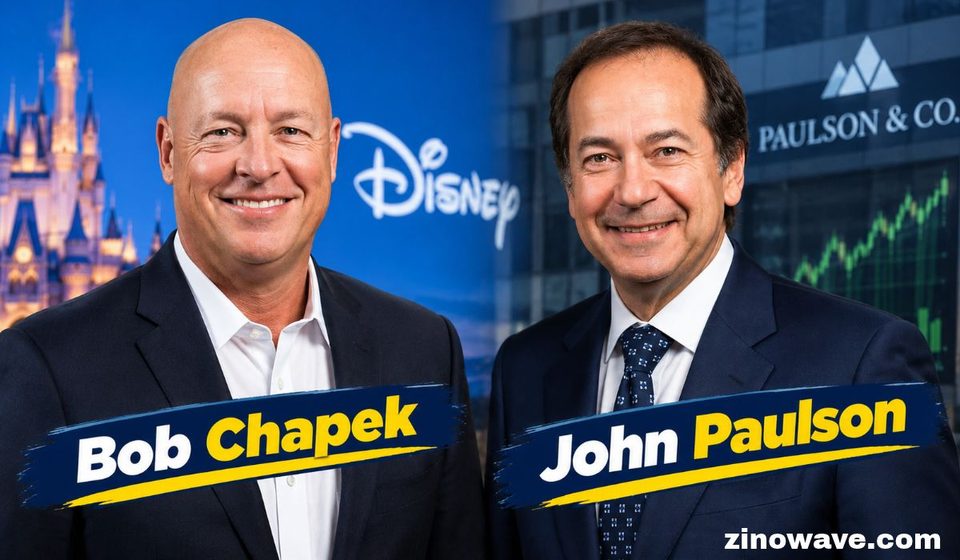
Bob Chapek and John Paulson both reached the top of the business world. Yet they got there on very different roads. One climbed inside a famous entertainment company. The other built his own investment firm and made one of the biggest trades in market history.
This guide compares the two careers side by side. You will see how each man started, what he is known for, and what went right or wrong along the way. You will also learn why a corporate chief executive and a hedge fund founder face very different pressures. If you study business, work in finance, or simply enjoy business stories, the contrast is worth a closer look.
Bob Chapek’s career at Disney
Bob Chapek spent almost thirty years at The Walt Disney Company. He joined in 1993 and started in marketing inside the home video business. That is a long way from the glamour of theme parks or blockbuster films. Still, it taught him how to sell products to families, and Disney has always depended on families.
Over the next two decades he moved through home entertainment, studio roles and consumer products. He built a reputation as a careful operator who liked numbers, pricing and process. Colleagues saw him as a manager who could run large and complex units. That reputation helped him earn one of the biggest operating jobs in the company.
In 2015, Chapek took charge of Disney’s parks and resorts. In 2018, the company reorganized and gave him the combined Parks, Experiences and Products group. This unit covers theme parks, hotels, cruise ships and consumer goods. It produces a very large share of Disney’s profit, so the role carried real weight.
| Year | Career step |
|---|---|
| 1993 | Joined Disney in home entertainment marketing |
| 2015 | Became head of parks and resorts |
| 2018 | Led the new Parks, Experiences and Products group |
| February 2020 | Became CEO of Disney, taking over from Bob Iger |
| November 2022 | Replaced by the board, with Iger returning |
Chapek became CEO in February 2020. The timing was harsh. Within weeks, the COVID-19 pandemic forced Disney to close its parks and pause many film releases. Revenue from the business he knew best dropped sharply. He also had to steer a major shift toward streaming, since Disney+ had launched only a few months earlier.
His tenure had real achievements. Disney+ added tens of millions of subscribers. The parks reopened and recovered. He also centralized decisions about where and how Disney content would be released. Supporters said he kept the company running through a historic crisis. They also pointed to new paid park services, such as Genie+ and Lightning Lane, as smart ways to raise revenue.
The criticism, however, kept growing. Many creative teams felt sidelined by the new structure. A lawsuit from actor Scarlett Johansson over the streaming release of Black Widow hurt Disney’s image with talent. Many employees and fans also felt his early response to a Florida education law was too slow. Investors, meanwhile, worried about the cost of streaming.
Here is a quick view of what helped and hurt him:
- Strengths: deep knowledge of parks and consumer products, steady focus on operations, and strong streaming growth during his term.
- Weaknesses: strained ties with creative leaders, criticism of his public communication, and investor concern about streaming losses.
- Result: a board that lost confidence faster than he could rebuild it.
In November 2022, the board replaced Chapek with Bob Iger, his own predecessor. His contract had been meant to run for years more. The sudden change showed how fast a CEO’s job can end when trust fails. It also showed that a CEO answers to a board, not only to customers.
John Paulson’s investment career
John Paulson was born in Queens, New York, in 1955. He studied at New York University and later earned an MBA at Harvard Business School. After school he worked in consulting and then in dealmaking roles on Wall Street, including time at Bear Stearns. Those jobs taught him how deals are priced and how companies fail.
In 1994, he started his own firm, Paulson & Co. It began small and focused on merger arbitrage and event-driven investing. That means betting on how corporate deals, bankruptcies and restructurings will play out. The firm grew slowly for years. For most of that time, Paulson was a respected but little-known money manager.
That changed in 2006 and 2007. Paulson and his team became convinced that the US housing market was in a bubble. They bought credit default swaps, which work like insurance, on risky mortgage securities. When home prices fell and defaults rose, the bets paid off in a huge way. Reports at the time said the firm earned about 15 billion dollars, and Paulson himself earned around 4 billion.
| Period | Main focus | Outcome |
|---|---|---|
| 1994 to early 2000s | Merger arbitrage and event-driven deals | Steady growth |
| 2006 to 2007 | Bets against risky mortgage securities | Record profits |
| 2008 to 2010 | Gold, bank stocks and recovery trades | Strong gains and rising assets |
| 2011 onward | Several large, costly bets | Fund sizes fell sharply |
After the crisis, Paulson made new big calls. He backed gold heavily. He also bought bank stocks and assets tied to a housing recovery. At its peak, his firm managed more than 30 billion dollars. Success on that scale brought fame, new investors and a place on rich lists around the world.
Also Read This Blog Howard Schultz and George Soros: Their Political Connection Explained
Then luck turned. In 2011, some of his funds suffered heavy losses. Gold prices later fell as well. Many investors pulled out their money, and the firm shrank. In recent years, the firm has focused mostly on managing his own and family wealth rather than money from outside clients.
Paulson is also known for giving. He donated 400 million dollars to Harvard’s engineering school, which now carries his name. He also gave 100 million dollars to the Central Park Conservancy in New York. These gifts made him as well known for philanthropy as for trading.
Several lessons stand out from his path:
- Research pays off. His housing trade came from long, detailed study, not a lucky guess.
- Concentrated bets cut both ways. Big positions created big wins and big losses.
- Repeating success is hard. One great trade did not guarantee the next one.
- Investor trust is fragile. Poor results led clients to leave quickly.
Paulson’s story shows how one well-timed idea can change a career. It also shows how hard it is to stay on top afterward. Markets reward conviction, but they punish overconfidence just as fast.
How their business roles differed
At first glance, both men look like top executives. In practice, their jobs were very different. Chapek ran a giant company with tens of thousands of workers. Paulson ran a small team that made investment decisions with money. One managed people and brands. The other managed risk and capital.
| Area | Bob Chapek | John Paulson |
|---|---|---|
| Job type | Salaried corporate executive | Founder and owner of an investment firm |
| Main task | Run a global entertainment company | Choose investments and manage risk |
| Whose money | Shareholders’ company assets | Client money and his own capital |
| Who he answered to | A board and public shareholders | Fund investors and his own judgment |
| Team size | Very large, spread across the world | Small, focused on research and trading |
| Time horizon | Years of brand and strategy building | Trades that could pay off in months or years |
| Measure of success | Revenue, profit, subscribers, brand health | Investment returns and assets under management |
| How it ended | Removed by the board | Outside money fell, and the firm shrank |
The first big difference is the kind of decision each man made. A CEO makes thousands of choices that depend on other people. Chapek had to align creative teams, park managers, marketers and streaming leaders. A single weak link could slow the whole company. Paulson, by contrast, could act on one strong idea and place a large bet quickly.
The second difference is accountability. Chapek reported to a board that could remove him at any time. Public opinion, employee feedback and media stories all fed into that decision. Paulson answered to investors, who could withdraw their money. His results were easy to measure. Either the fund went up or it did not.
The third difference is how success looked. A CEO such as Chapek is judged on many things at once. These include profit, culture, creative output and public image. A hedge fund founder such as Paulson is judged mainly on returns. That makes his job simpler to score, but it also makes it less forgiving during a bad stretch.
The skills also differ. Chapek’s role called for leadership, communication and patience. He had to calm staff, persuade partners and balance the needs of many groups. Paulson’s role called for research, timing and nerve. He had to hold a view that most people rejected, and he had to stay calm under pressure.
Still, the two careers share some common ground:
- Both men had to read risk early and act on it.
- Both faced sharp public criticism after major setbacks.
- Both learned that timing can matter as much as talent.
- Both saw that trust from boards or investors can disappear quickly.
These links show that different jobs can teach the same hard lessons. A leader inside a company and a trader outside it both live with uncertainty. The tools differ, but the pressure is similar.
Also Read This Blog Kobe Bryant and Sam Zell: Their Documented Connection
Frequently Asked Questions
Who is Bob Chapek?
Bob Chapek is a former CEO of The Walt Disney Company. He led the company from February 2020 to November 2022 after a long career in parks, products and home entertainment.
Who is John Paulson?
John Paulson is an American investor and the founder of Paulson & Co. He became famous for betting against risky mortgage securities before the 2008 financial crisis.
Why did Disney replace Bob Chapek?
Disney’s board lost confidence after a rocky period. Concerns included weak communication, strained creative relationships, and worries about streaming costs.
How did John Paulson make his fortune?
He made most of his fortune from a large bet against subprime mortgage securities in 2007. He later added gains from gold and other trades.
Did Bob Chapek and John Paulson work in the same industry?
No. Chapek worked in entertainment, parks and consumer products at Disney. Paulson worked in finance and investing.
What is the main difference between a CEO and a hedge fund manager?
A CEO runs a company and leads many people. A hedge fund manager invests money and is judged mainly on returns.
What can business students learn from both careers?
They can learn that strong results need both skill and timing. They also learn that trust from boards and investors must be earned again and again.
Final Thoughts
Bob Chapek and John Paulson show two different ways to reach the top of business. Chapek rose through one famous company and learned how to run parks, products and brands at huge scale. His story shows the strength of deep operating skill. It also shows how quickly a leader can lose support when communication and trust slip.
Paulson built his own firm and made one of the boldest trades of his era. His story shows the power of research and conviction. It also shows how hard it is to repeat a great win. Put side by side, the two careers remind us that titles and fortunes can change fast. What lasts is the ability to learn, adapt and earn trust.
Samuel is a Bible content writer with 5 years of experience in researching Bible verses, prayers, blessings, and biblical name meanings. He shares meaningful insights to help readers understand Scripture better.


[…] Also Read This Blog Bob Chapek and John Paulson: Business Careers Compared […]
[…] Also Read This Blog Bob Chapek and John Paulson: Business Careers Compared […]