
The Concept of a Biblically Accurate God
The true nature of God revealed in the Bible reaches far beyond human imagination, language, and understanding. Throughout Scripture, God is presented not as a being limited by human characteristics or physical form, but as the eternal Creator who is holy, all-powerful, all-knowing, and present everywhere. While people have sought to describe God through art, philosophy, and tradition for centuries, the Bible consistently points to a reality that surpasses every human attempt to define Him fully.
This guide explores the biblical understanding of God’s nature by examining His divine attributes, manifestations, and the ways He reveals Himself throughout Scripture. Drawing from both the Old and New Testaments, it explains what the Bible teaches about God’s glory, character, and relationship with humanity, offering a clearer picture of the One whose greatness extends beyond human imagination.
Core Divine Attributes Revealed in Scripture
Essential Divine Attributes
Theologians often sort God’s attributes into two groups: incommunicable attributes (qualities unique to God alone, like omnipotence, omniscience, and eternity) and communicable attributes (qualities humans can reflect in a limited way, like love, faithfulness, and justice). Scripture doesn’t present these as a checklist but as a living portrait, each attribute reinforcing the others.
Among the attributes most emphasized throughout the biblical text:
- Omnipotence, God’s unlimited power, seen in creation itself (Genesis 1:1) and in His ability to accomplish His purposes without obstruction (Psalm 115:3).
- Omniscience, God’s complete knowledge, including the future and the human heart (Psalm 147:5; Hebrews 4:13).
- Holiness, God’s absolute moral purity and “otherness,” famously declared by the seraphim in Isaiah’s vision (Isaiah 6:3).
- Righteousness and justice, God’s commitment to what is right and His refusal to leave wrong unaddressed (Deuteronomy 32:4; Psalm 89:14).
- Love, Not a passing emotion but God’s very essence, described directly as such in 1 John 4:8.
- Faithfulness, God’s unwavering reliability across generations (Deuteronomy 7:9; Proverbs 3:3).
- Eternality and immutability, God exists outside time and does not change (Psalm 90:2; Malachi 3:6).
No single attribute tells the whole story. A God who was only powerful would be terrifying. A God who was only loving, without justice, would tolerate evil indefinitely. The biblical God holds all these qualities together in perfect, unified harmony.
God’s Various Forms and Manifestations
Key Distinctions in Divine Manifestation
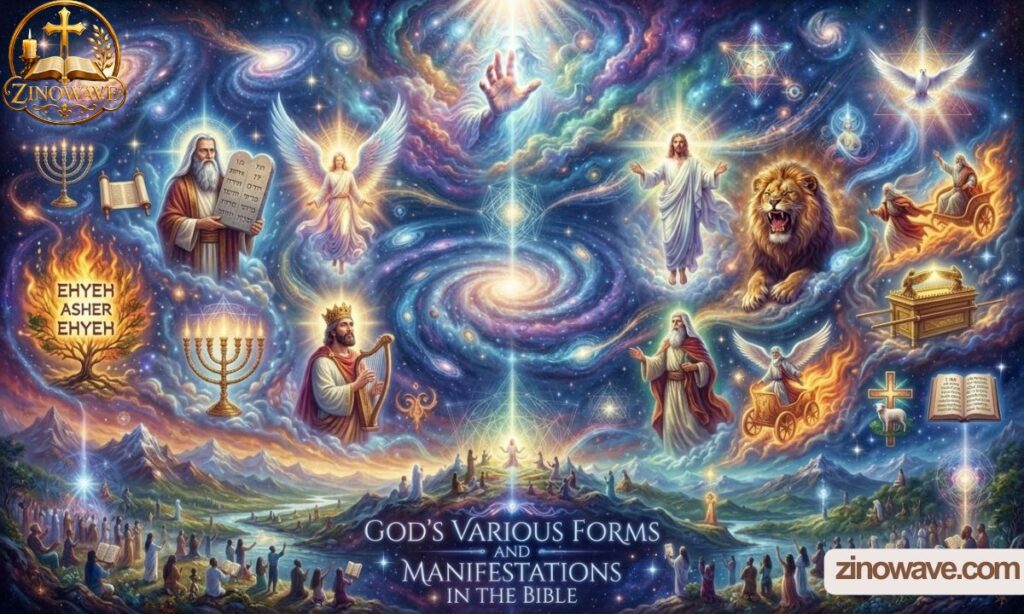
Scripture is clear that God, in His essential being, is spirit, invisible, without physical form (John 4:24). Yet throughout the biblical narrative, God repeatedly makes Himself perceptible to human senses. Theologians call these appearances theophanies, visible or sensory manifestations of the invisible God for a specific purpose, without exhausting or fully containing His infinite nature.
This distinction matters: when God appears in fire, cloud, or human form, He is not “becoming” smaller or fully material. He is condescending, graciously accommodating Himself to human limitation so that people can encounter Him without being destroyed by unmediated divine glory.
Biblical Descriptions of God’s Appearance
Some of the most vivid manifestations in Scripture include:
- The burning bush (Exodus 3:2), God appears in fire that burns without consuming, calling Moses into his life’s mission.
- The pillar of cloud and fire (Exodus 13:21), guiding and protecting Israel through the wilderness.
- Smoke, thunder, and trumpet blast at Sinai (Exodus 19:16-18), God’s holiness made almost unbearably tangible to an entire nation.
- The “angel of the LORD”, appearances throughout the Old Testament that many scholars understand as pre-incarnate appearances of the Son.
Prophetic Visions of Divine Glory
The prophets received some of the most breathtaking glimpses of God’s throne room:
- Isaiah 6, Isaiah sees the Lord “high and lifted up,” with seraphim calling out His holiness, and the temple filling with smoke.
- Ezekiel 1, a vision of wheels, living creatures, and a throne of sapphire blazing with fire and rainbow light, so overwhelming that Ezekiel falls facedown.
- Daniel 7, the “Ancient of Days,” clothed in white, seated on a throne of flame.
- Revelation 4, John’s vision of the heavenly throne room, encircled by a rainbow, filled with worship day and night.
These visions share a pattern: overwhelming light, fire, and glory, and a human response of awe, trembling, or falling down, the opposite of casual familiarity.
Progressive Revelation of God’s Character
Stages of Divine Self-Disclosure
God did not reveal everything about Himself all at once. Scripture unfolds His character in stages, each building on what came before:
- Creation, God reveals His power, order, and creativity (Genesis 1-2; Romans 1:20).
- The Patriarchs, God reveals His faithfulness through covenant promises to Abraham, Isaac, and Jacob.
- The Exodus and Law, God reveals His holiness, justice, and redeeming power, rescuing Israel and giving moral instruction.
- The Prophets, God reveals His heart for justice, mercy, and a coming restoration.
- The Incarnation, God reveals Himself completely and personally in Jesus Christ (Hebrews 1:1-3).
- The Church Age, God reveals Himself relationally through the indwelling Holy Spirit.
- The Consummation, God will be fully and unveiledly present with His people (Revelation 21:3).
This is often compared to a photograph developing in a darkroom: the image doesn’t change, it simply becomes clearer over time. God isn’t evolving, our understanding is catching up to who He has always been.
Experiencing the Presence of God in Everyday Life
Knowing these truths intellectually is only the starting point. Scripture consistently invites ordinary people into lived experience of God’s presence, not just facts about Him, but companionship with Him.
Moses at the burning bush wasn’t handed a theology lesson; he was called into a relationship that reshaped the rest of his life. The same invitation extends to anyone who reads these accounts today: God is described as near to the brokenhearted (Psalm 34:18), present in prayer (Philippians 4:6-7), and active in ordinary circumstances, not only in dramatic visions.
Jesus Christ: The Complete Revelation of God
Christ as the Perfect Image of God
If someone wants to know exactly what God is like, Scripture points to one place: Jesus Christ. Colossians 1:15 calls Christ “the image of the invisible God,” and Hebrews 1:3 describes Him as the “radiance of God’s glory and the exact representation of his being.” Jesus Himself told His disciples that anyone who had seen Him had seen the Father (John 14:9).
Jesus as God’s Exact Representation
This isn’t poetic exaggeration. The claim is that in the person of Jesus, the invisible, infinite God became visible, touchable, and knowable in human history, without ceasing to be fully God.
Every previous manifestation of God in Scripture pointed toward this moment; Christ is the fullest and final Word (Hebrews 1:1-2).
Divine Attributes Displayed Through Jesus
Christ’s Demonstration of Divine Attributes
In the Gospels, the attributes theologians describe abstractly become concrete actions:
- Power, calming storms, healing the sick, raising the dead.
- Knowledge, perceiving people’s hidden thoughts and futures.
- Holiness, living a sinless life while remaining approachable to sinners.
- Justice and mercy together, confronting religious hypocrisy while extending forgiveness to the repentant.
- Love, culminating in His willing death on the cross for those who had wronged Him.
Jesus as the Key to Understanding Scripture
Christ as the Interpretive Lens
Jesus repeatedly reframed how His listeners understood the Hebrew Scriptures, showing that the entire Old
Testament pointed toward Him (Luke 24:27). Difficult or puzzling Old Testament passages are best read in light of the character Jesus ultimately reveals, a God who is just and merciful, never capricious or cruel.
God’s Redemptive Work Through Christ
Christ’s Redemptive Accomplishments
The cross stands as the single event where every divine attribute converges: justice is satisfied, love is displayed, mercy is extended, and holiness is honored, all simultaneously, through Christ’s substitutionary death and resurrection (Romans 3:25-26). This is the heart of the gospel: God doesn’t overlook sin to love people, and He doesn’t punish sin at the cost of loving them. Both happen fully, at once, in Christ.
Essential Characteristics of the Biblically Accurate God
Divine Omnipotence and Omniscience
How God’s Power and Knowledge Work Together
God’s power is never blind force; it’s guided by perfect knowledge and wisdom. Because God knows the end from the beginning (Isaiah 46:10),
His power is always exercised purposefully, never randomly. This combination is what allows Scripture to describe God’s plans as trustworthy rather than merely strong.
Perfect Holiness and Righteous Justice
The Relationship Between Holiness and Justice
Holiness describes God’s absolute purity and “set-apartness” from sin; justice is holiness in action toward moral wrong.
Because God is holy, He cannot treat sin as though it doesn’t matter, that would contradict His own nature. Justice, then, isn’t an arbitrary rulebook; it flows directly from who God is.
Boundless Love and Abundant Mercy
Divine Love and Mercy in Action
Biblical love is not primarily a feeling; it is committed, active, and sacrificial, most clearly seen in God’s willingness to send His Son (John 3:16). Mercy is the practical outworking of that love: withholding deserved judgment and offering grace instead.
The Eternal Nature of God: Unchanging Across Time and Creation
God exists outside of time altogether. He had no beginning and will have no end (Psalm 90:2), and His character does not shift with circumstances, culture, or era (Malachi 3:6; Hebrews 13:8). This unchanging nature is a source of stability: the God who kept His promises to Abraham is the same God at work today.
The Triune Nature of God: Father, Son, and Spirit
Biblical Foundation for the Trinity
Scriptural Evidence for Trinitarian Doctrine
The word “Trinity” never appears in Scripture, but the concept, one God eternally existing in three distinct persons, is built from cumulative biblical evidence:
- Genesis 1:26, God speaks of Himself in the plural (“Let us make mankind in our image”), hinting at plurality within unity.
- Deuteronomy 6:4, the foundational declaration that God is one; the Hebrew word used allows for a unified plurality rather than strict singularity.
- Matthew 3:16-17, at Jesus‘ baptism, the Son is baptized, the Spirit descends, and the Father speaks from heaven, three persons active in a single moment.
- Matthew 28:19, the baptismal formula names Father, Son, and Holy Spirit under one shared “name.”
- 2 Corinthians 13:14, Paul’s benediction addresses all three persons together.
God the Father’s Role
The Father’s Work in Redemption
Scripture presents the Father as the initiator of the plan of salvation, planning redemption, sending the Son, and adopting believers as His children (Ephesians 1:3-5). He is consistently portrayed as source, planner, and sustaining authority within the Godhead’s shared work.
God the Son’s Work
Christ’s Divine and Mediatorial Functions
The Son accomplishes redemption, living, dying, and rising to reconcile humanity to God, and now serving as mediator and intercessor (1 Timothy 2:5; Hebrews 7:25).
God the Holy Spirit’s Ministry
The Spirit’s Multifaceted Work
The Spirit applies redemption personally, convicting of sin, regenerating hearts, indwelling believers, producing spiritual fruit, and empowering for ministry (John 16:8; Galatians 5:22-23).
The Relational Character of God
Because God exists eternally as three persons in perfect relationship, relationship itself is built into the fabric of who He is. This is part of why Scripture says humans were created for relationship, made in the image of a relational God (Genesis 1:27; John 17:21).
Implications of God’s Triune Nature
The Trinity isn’t abstract math (“three equals one”); it shapes how believers understand salvation as an invitation into the very fellowship shared between Father, Son, and Spirit, not just a legal transaction but genuine belonging.
Correcting Common Misconceptions About God
Why Distorted Views of God Develop
Sources of Theological Distortion
Most inaccurate pictures of God come from a handful of recurring sources:
- Cultural conditioning, absorbing a comfortable, consumer-friendly deity from the surrounding culture rather than Scripture.
- Painful personal experience, projecting the failures of an absent or harsh parent onto God.
- Selective reading, building a theology from favorite verses while ignoring the rest of the biblical witness.
- Inadequate teaching, churches or traditions that emphasize comfort over the full counsel of Scripture.
False Images That Misrepresent God
Common Distortions of God’s Character
Two opposite errors show up repeatedly:
- God as pure, permissive love, a “cosmic grandfather” who overlooks sin and never confronts wrongdoing.
- God as pure wrath, a distant, angry judge waiting for an excuse to punish, with little room for mercy.
Both distortions cherry-pick a single attribute and ignore the rest, producing either presumption or dread instead of genuine reverence.
How Scripture Corrects Our Understanding
Process for Correcting Misconceptions
A helpful pattern for correcting a distorted view: name the specific misconception honestly, locate Scripture passages that directly address it, study those passages in their full context, and let the whole counsel of Scripture, not an isolated verse, shape the conclusion.
Reconciling Old and New Testament Portraits of God
Progressive Revelation Explained
Understanding Development in Divine Disclosure
A common objection is that the God of the Old Testament, associated with conquest and judgment, seems different from the gentler God of the New Testament. Progressive revelation resolves this: God’s self-disclosure became clearer over time, but His character never changed.
God’s Consistent Character Throughout Scripture
Divine Attributes Across Both Testaments
The same attributes appear in both Testaments: love (Deuteronomy 7:8-9; John 3:16), holiness (Leviticus 11:44; 1 Peter 1:15-16), and mercy (Exodus 34:6-7; Ephesians 2:4-5). What differs is emphasis and clarity, not substance.
Divine Judgment Across Both Testaments
Continuity of Divine Justice
Judgment isn’t absent from the New Testament (see Revelation’s depictions of final judgment), and mercy isn’t absent from the Old Testament (see the entire book of Hosea). Both Testaments hold justice and mercy together; the perceived contrast is often a matter of selective reading.
Christ’s Interpretation of Difficult Passages
Jesus’ Hermeneutical Approach
Jesus treated the Old Testament as fully authoritative while also reframing how it should be understood, for example, correcting distorted applications of the Law (Matthew 5:21-48) while affirming its underlying purpose (Matthew 5:17).
Unity of God’s Redemptive Plan
Consistent Redemptive Thread
From the first promise in Genesis 3:15 to the final restoration in Revelation 21-22, Scripture traces a single unfolding plan of redemption, all centered on Christ.
Common Misinterpretations Regarding God’s Nature
Balancing Divine Love and Justice
How Love and Justice Coexist
Perhaps the most common theological imbalance is choosing love over justice or justice over love, as if they compete. The cross is the biblical answer: love and justice meet fully and simultaneously in Christ’s atoning death, neither one diminished by the other.
Understanding Sovereignty and Human Responsibility
The Paradox of Divine Control and Human Choice
Scripture affirms both that God is fully sovereign over history (Isaiah 46:10; Ephesians 1:11) and that human beings are genuinely responsible
for their choices (Joshua 24:15; Romans 2:6). The Bible never fully resolves the philosophical tension between these truths, it simply affirms both, inviting humility rather than forced simplification.
Why Biblical Accuracy Matters in Understanding God
Knowing God as He Truly Is
Scripture as the Sole Reliable Source
Without Scripture as the anchor, people either shrink God down to a manageable, human-sized figure or inflate Him into a vague, impersonal force. The Bible remains the most reliable source for knowing who God actually is, rather than who we imagine or wish Him to be.
Guiding Faith and Daily Decisions
Practical Impact of Accurate Theology
Theology isn’t abstract. What someone believes about God’s character directly shapes how they pray, how they respond to suffering, how they treat other people, and what risks they’re willing to take in faith.
Building Authentic Personal Relationship
Intimacy Grounded in Truth
A relationship built on a distorted image of God is, in a real sense, a relationship with an idol, a substitute rather than the real thing.
Genuine intimacy with God requires knowing Him as He has revealed Himself, not as culture or personal preference has reshaped Him.
Countering False Representations
Correcting Theological Distortions
Popular portrayals, in art, media, or casual conversation, often reduce God to a bearded old man in the clouds or an impersonal cosmic force.
Returning again and again to Scripture is the primary corrective to these caricatures.
Life Transformation Through Knowing God’s True Nature
From Fear to Confident Assurance
Replacing Dread with Bold Access
A biblically accurate view of God replaces anxious dread with confident access. Believers are invited to approach
God’s throne “with confidence” rather than terror (Hebrews 4:16), because Christ has already dealt with what separated humanity from God.
From Religious Performance to Grace-Based Rest
Shifting from Striving to Receiving
Understanding grace correctly shifts the Christian life from exhausting performance, trying to earn God’s approval, to resting in what has already been accomplished through Christ (Ephesians 2:8-9).
Worship Marked by Reverence and Intimacy
Balanced Worship Characteristics
Accurate knowledge of God produces worship that holds reverence and closeness together, awe at His holiness alongside genuine affection, rather than either cold formality or shallow familiarity.
Prayer Grounded in Trust
Confidence in God’s Character
Knowing God’s character transforms prayer from a wish-list ritual into genuine conversation, rooted in trust that He is both powerful enough to act and good enough to be trusted with the outcome.
Living with Divine Purpose and Hope
Transformational Outcomes
An accurate view of God anchors a person’s sense of purpose and hope, even amid hardship, because it rests on who God is rather than on circumstances.
Practical Steps to Learn About the Biblically Accurate God
Systematic Study of Biblical Texts
Organized Approach to Studying God’s Attributes
Rather than reading at random, a more fruitful approach is to:
- Choose one attribute of God (such as faithfulness or holiness) and trace it through Scripture over a set period.
- Study books especially rich in the character of God, the Psalms for devotional reflection, Isaiah for prophetic vision, Romans for systematic theology.
- Use tools like a concordance to locate every occurrence of key words, and trustworthy commentaries for historical and literary context.
Seeking Divine Guidance Through Prayer
Prayer Practices for Deeper Understanding
Study alone can remain purely academic. Praying before reading, asking for understanding and humility, turns information into transformation,
letting the Spirit illuminate what’s read (1 Corinthians 2:12-14).
Community and Fellowship’s Vital Role
Maximizing Communal Learning
Theology studied in isolation is more prone to error. Engaging with a Bible-teaching community, through preaching, group discussion, and
shared accountability, helps test personal interpretations against the wider body of believers.
Conclusion
The God revealed in Scripture refuses to fit into any single human category. He is transcendent yet near, powerful yet gentle, perfectly just yet endlessly merciful. He cannot be reduced to a comforting therapist or an angry tyrant, He is something far richer than either caricature. The clearest window into this character is Jesus Christ, in whom the fullness of God became visible, touchable, and knowable.
Pursuing an accurate understanding of God isn’t a academic side project; it’s the foundation for genuine worship, confident prayer, and a life shaped by hope rather than fear. The invitation of Scripture, from beginning to end, is simple: come and see God as He actually is.
Frequently Asked Questions
Is the God of the Old Testament different from the God of the New Testament?
No, the same attributes appear in both Testaments; only the clarity of God’s self-revelation increases over time, not His character.
Why does the Bible describe God appearing in fire, clouds, or human form if He is spirit?
These appearances (theophanies) are God graciously accommodating Himself to human limitation so people can encounter Him without being overwhelmed.
How can God be both loving and just at the same time?
The cross of Christ shows both fully at once: justice against sin is satisfied while love for sinners is displayed, in the same act.
What is the best place to start if I want to understand God’s character more accurately?
Start with the Gospels to see God’s character embodied in Jesus, then use the Psalms and a concordance to trace His attributes through the rest of Scripture.
Does the Bible explain the Trinity directly?
The word “Trinity” never appears in Scripture, but the doctrine is built from cumulative passages showing one God existing eternally as three persons.
How does understanding God’s true nature change everyday life?
It reshapes prayer, worship, and daily decisions from fear and self-effort into confident trust grounded in who God actually is.

Samuel is a Bible content writer with 5 years of experience in researching Bible verses, prayers, blessings, and biblical name meanings. He shares meaningful insights to help readers understand Scripture better.